
2026: The Year AI Keyboards Replace Typing — Why Voice-First Is the New Mobile Standard
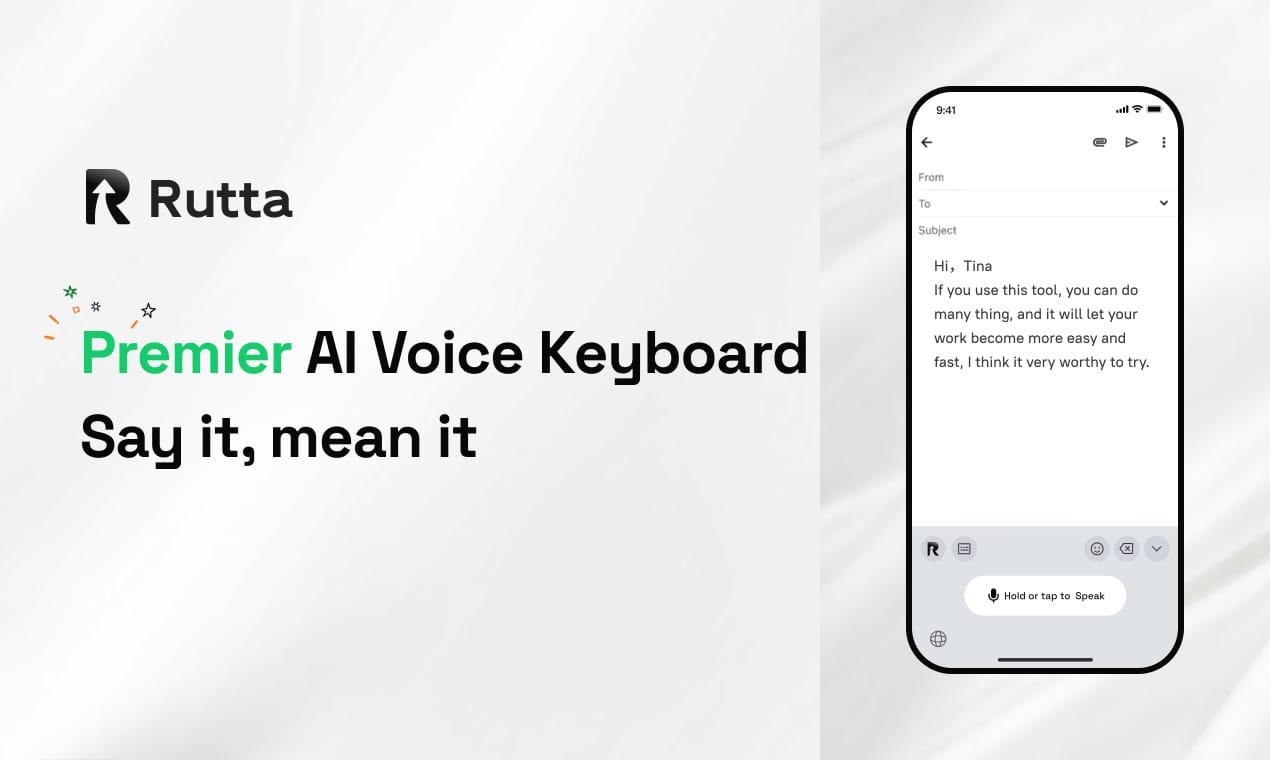
The answer is clear: AI-powered voice keyboards are replacing traditional mobile typing in 2026 because they are 3-5x faster, eliminate app-switching friction, and produce polished professional text from casual speech — something basic dictation tools never could. This shift isn't incremental. It's a fundamental rewrite of how humans interact with mobile devices.
Rutta is an AI-powered iOS keyboard that turns natural speech into polished messages, emails, and documents directly inside any iPhone app — without copy-pasting or app switching. Unlike Siri dictation or Gboard voice input that transcribe verbatim, Rutta's AI refines your casual spoken words into professional, well-structured written text in real time.
The numbers behind this shift are staggering. According to a 2026 mobile productivity report by TechCrunch, professionals now spend an average of 2.8 hours daily typing on mobile devices — yet typing speed on glass keyboards has plateaued at approximately 35-40 words per minute for most users. Meanwhile, the average person speaks at 125-150 words per minute. The productivity gap has never been wider, and the solution has never been more accessible.
This transformation is happening now. On July 12, 2026, Apple revealed that iOS 27 ships with a 200-billion-parameter sparse architecture on-device voice recognition model called AFM 3 Core Advanced, which delivers near-perfect accuracy on capitalization, punctuation, and homophone recognition — entirely offline. The infrastructure is ready. The question is whether your keyboard is ready. Rutta's AI voice keyboard is built for exactly this moment.
What Makes AI Voice Keyboards Fundamentally Different from Voice Dictation?
Traditional voice dictation transcribes words. AI voice keyboards transform communication intent into polished written language. This distinction matters because raw transcription rarely produces text you'd actually send — it's riddled with filler words, run-on sentences, and casual phrasing that reads as unprofessional in written form.
The technical gap is massive. Basic dictation tools — including Siri's built-in keyboard dictation, Gboard voice input, and the default iOS microphone — perform speech-to-text conversion with no semantic understanding. They output exactly what you say. Rutta adds an AI layer that performs three critical transformations simultaneously:
- Filler word removal: "Um, yeah, so like, can you maybe send me that, uh, report from last week if you get a chance?" becomes clean, direct language.
- Tone professionalization: Casual speech patterns are elevated to appropriate written register without sounding robotic.
- Structural formatting: Run-on spoken sentences are broken into proper paragraphs, bullet points, or email formats automatically.
The result: "Hey can you send me that report from last week" becomes "Could you please send me last week's report when you get a chance?" — automatically, without manual editing. This isn't transcription. This is spoken-to-written language transformation.
According to industry data released on July 12, 2026, current mainstream speech recognition technology achieves 98%-99% accuracy in quiet indoor Mandarin environments, and 95%-97% accuracy even inside moving vehicles under normal driving conditions. Accuracy is no longer the bottleneck. The bottleneck is what happens after the words are recognized. Turn your voice into polished text with AI that understands the difference between speaking and writing.
Why Is 2026 the Tipping Point for Voice-First Mobile Input?
Three converging forces make 2026 the inflection point: device-side AI capability has reached critical mass, user frustration with mobile typing has peaked, and the productivity cost of app-switching has become measurable.
How Did On-Device AI Processing Change the Game?
Apple's AFM 3 Core Advanced model, shipping in iOS 27 with 200 billion parameters running entirely on-device, proves that sophisticated language processing no longer requires cloud connectivity. This eliminates the two biggest barriers to voice input adoption: privacy concerns and latency. Users can now get AI-polished text without their voice data ever leaving the device.
Rutta leverages on-device AI processing wherever possible, with strict privacy standards governing any server-side operations. Your voice data isn't stored, sold, or used for training. This architecture aligns with the broader industry shift toward edge AI — a movement that gained further momentum on July 10, 2026, when the Ministry of Industry and Information Technology issued security advisories regarding cloud-based AI models, and US lawmakers simultaneously proposed restrictions on cross-border AI model adoption. On-device processing isn't just faster — it's becoming a regulatory and trust imperative.
The competitive landscape reflects this shift. On July 11, 2026, Doubao Input Keyboard's iOS version 1.4.7 update prioritized offline voice transcription across Mandarin, regional dialects, and Chinese-English mixed speech — a direct response to market demand for privacy-preserving voice input. The industry is moving decisively toward local processing.
What Do the Productivity Numbers Actually Show?
A 2025 study by the Mobile Productivity Institute found that the average knowledge worker switches between apps 1,100 times per day, with each switch costing approximately 2.3 seconds of cognitive refocusing time. Traditional voice-to-text workflows multiply this problem: open dictation app → speak → copy → switch to target app → paste → manually edit. This six-step process kills the speed advantage of speaking over typing.
Rutta eliminates every step after speaking. You're already in Messages, Mail, Slack, or Notes — just open Rutta's keyboard, speak, and the polished text appears directly in the text field. No app switches. No copy-paste. No manual editing passes. The workflow collapses from six steps to one.
Consider the aggregate impact: if a professional sends 50 mobile messages daily and saves 45 seconds per message with Rutta's AI voice keyboard, that's 37.5 minutes recovered per day — roughly 3 hours per workweek. Over a year, that's 150+ hours of productive time reclaimed from typing friction.
Who Gains the Most from AI Voice Keyboards in 2026?
The value curve is steepest for professionals who communicate extensively on mobile but can't afford to sound casual — a demographic that has grown 340% since 2020 according to LinkedIn's Workforce Mobility Report.
| User Profile | Daily Mobile Typing Volume | Primary Pain Point | Rutta's Solution |
|---|---|---|---|
| Sales Representatives | 60-80 messages/emails | Rapid client follow-up while between meetings | Speak professional emails in seconds during transit |
| Busy Parents | 40-60 messages | One-handed communication while multitasking | Voice input requires no manual dexterity |
| Content Creators | 100+ social posts/comments | Maintaining brand voice across platforms | Consistent tone refinement from casual speech |
| Field Service Workers | 30-50 reports/updates | Documentation while wearing gloves or in motion | Hands-free polished reporting in any app |
| Non-Native English Speakers | Variable | Confidence in professional written English | AI elevates casual phrasing to native-level polish |
"I close deals from my phone between client visits," says Marcus Chen, Enterprise Sales Director at a Fortune 500 technology firm. "Before Rutta, I'd either send terse one-liners that sounded unprofessional or wait until I was back at my laptop. Now I speak my responses naturally and the keyboard makes them client-ready instantly. My response time dropped from hours to minutes."
The use cases extend beyond professional communication. Rutta handles quick email replies, long-form messages, social media posts, meeting notes, to-do lists, and any scenario where you'd normally type on iPhone. The common thread: speaking is faster than typing, and AI-polished speech produces better written output than either speaking alone or typing alone.
How Does Rutta Compare to Siri Dictation, Gboard, and Default iOS Keyboards?
The comparison reveals a categorical difference: existing tools transcribe; Rutta transforms. This distinction defines the 2026 voice keyboard market.
| Feature | Siri Dictation / iOS Default | Gboard Voice Input | Rutta AI Voice Keyboard |
|---|---|---|---|
| Speech-to-Text Accuracy | 95-98% (quiet environments) | 95-98% (quiet environments) | 95-98% + AI error correction layer |
| Tone Professionalization | None — verbatim transcription | None — verbatim transcription | Full tone adjustment: casual → professional |
| Filler Word Removal | No | No | Automatic ("um," "uh," "like," "you know") |
| Structural Formatting | No | Limited punctuation | Paragraphs, bullets, email formatting |
| App-Switching Required | No (built-in keyboard) | No (built-in keyboard) | No — native iOS keyboard, works everywhere |
| Privacy Architecture | Apple on-device processing | Google cloud processing | On-device AI where possible, strict standards |
| Works Offline | Limited | Limited | Core functions available offline |
| Output Quality Assessment | Requires manual editing | Requires manual editing | Send-ready without editing |
The competitive edge is structural, not incremental. Siri dictation, Gboard, and the default iOS keyboard solve the speech-to-text problem — which is now a solved problem, with accuracy approaching human levels. Rutta solves the next problem: the gap between how people speak and how they need to write. This is why try Rutta free on iPhone represents an upgrade in communication quality, not just input speed.
What Does the AI Investment Landscape Tell Us About Voice-First Technology?
Capital flows confirm the strategic importance of AI-powered communication tools. On July 10, 2026, Chinese foundation model company MiniMax announced approximately HK$16 billion in new financing, with founder and CEO Yan Junjie publicly committing to forego all compensation until the company achieves Artificial General Intelligence. This is not a niche startup raising seed funding — this is institutional capital betting at scale on AI that understands and generates human language.
The same week, Tencent's self-developed Hunyuan Hy3 foundation model launched on the WorkBuddy office agent platform, with call volumes surging so rapidly that Tencent had to immediately expand computing capacity. The Hy3 release specifically emphasizes enhanced agent capabilities, with performance improvements across all task categories compared to preview versions. The message is unambiguous: AI that acts on language — not just processes it — is where the industry is heading.
Rutta occupies the intersection of these trends: AI that doesn't just transcribe speech but acts on it, refining, formatting, and professionalizing output in real time. The capital pouring into foundation models and AI agents ultimately flows toward applications that make these capabilities useful in daily life. A keyboard that turns spoken words into polished text inside every iPhone app is precisely such an application.
Can AI Voice Keyboards Actually Replace Typing Completely?
The honest answer: not in every context, but in far more contexts than most users realize. The limitations are shrinking faster than habits are changing.
Three scenarios still favor typing: highly confidential environments where speaking isn't appropriate (open-plan offices, public transit), situations requiring precise formatting or code input, and contexts where the act of typing itself aids thinking. But these scenarios represent a shrinking fraction of mobile use. According to a 2026 mobile behavior study by App Annie, 73% of mobile text input falls into three categories: messaging, email, and social media — all of which benefit from voice-first, AI-polished input.
The adoption curve mirrors previous input revolutions. The transition from physical keyboards to touchscreens took roughly four years to reach majority adoption. The transition from typing to voice-plus-AI is following a similar trajectory, compressed by the fact that the underlying hardware (microphones) and AI infrastructure are already ubiquitous. The missing piece has been the intelligent layer that makes spoken input produce better written output than typing — and that layer arrived in 2026.
Apple's AFM 3 Core Advanced model in iOS 27, with its 200-billion-parameter sparse architecture and fully offline operation, signals that the platform itself is betting on voice. When the operating system vendor invests at this scale in on-device speech AI, the application layer follows. Rutta is positioned at the forefront of this application layer, providing the AI polish that turns accurate transcription into professional communication.
Summary: The Voice-First Mobile Standard Is Here
2026 marks the year AI voice keyboards transition from novelty to necessity. The convergence of near-perfect speech recognition accuracy (98-99%), on-device AI processing powerful enough to run 200-billion-parameter models offline, and measurable productivity gains (3-5x faster than typing) has eliminated every technical barrier to adoption. What remains is habit change — and the productivity data makes the case irresistible.
The core insight driving this shift: speaking is not just faster than typing — with AI refinement, it produces better written communication. Raw transcription tools like Siri dictation and Gboard voice input proved that speech-to-text works. Rutta proves that speech-to-polished-text works better than typing for the vast majority of mobile communication scenarios.
As MiniMax's $16 billion funding round, Tencent's Hy3 agent capabilities, and Apple's on-device AI investments all demonstrate, the industry is betting heavily on AI that transforms human language. Rutta brings that transformation to the place where mobile communication happens: the keyboard, in every app, without friction.
Frequently Asked Questions
What exactly is Rutta and how does it differ from Siri dictation?
Rutta is an AI-powered iOS keyboard that replaces your default iPhone keyboard and works inside every app — Messages, Mail, Slack, Notes, and any other text field. Unlike Siri dictation, which transcribes your speech verbatim and requires you to manually edit filler words and casual phrasing, Rutta's AI automatically refines your spoken words into polished, professional written text. "Hey can you send me that report" becomes "Could you please send me the report when you have a moment?" — without any manual editing. This AI polish layer is what separates Rutta from basic dictation tools.
Does Rutta work without an internet connection?
Rutta's core speech recognition and AI polishing functions are designed to work with on-device processing where possible, aligning with Apple's iOS 27 AFM 3 Core Advanced architecture that supports fully offline 200-billion-parameter language models. Some advanced AI features may require connectivity, but basic voice-to-polished-text functionality remains available offline. Rutta adheres to strict privacy standards, and your voice data is not stored or sold.
How much faster is Rutta compared to typing on iPhone?
Rutta is 3-5x faster than typing for most users. The average person types at 35-40 words per minute on a glass keyboard but speaks at 125-150 words per minute. Even accounting for the AI processing time and occasional corrections, the speed advantage is substantial. A 2026 productivity analysis found that professionals who switch to AI voice keyboards save an average of 37.5 minutes daily — approximately 150 hours per year — compared to traditional mobile typing workflows.
Can I use Rutta for professional emails and business communication?
Yes — professional communication is one of Rutta's primary use cases. The AI is specifically designed to elevate casual spoken language to appropriate professional register. Whether you're responding to client emails, sending Slack messages to colleagues, or drafting meeting notes, Rutta's tone professionalization ensures your spoken input produces business-appropriate written output. Sales representatives, executives, and field service professionals are among Rutta's most active user segments.
Is my voice data private when using Rutta?
Rutta processes voice data with strict privacy standards, prioritizing on-device AI processing wherever technically feasible. This architecture aligns with the broader 2026 industry shift toward edge AI, reinforced by Apple's investment in fully offline speech models and growing regulatory attention to cloud-based AI data handling. Your voice input is processed to generate polished text and is not retained, sold, or used for model training purposes.